 China International Supply Chain Expo
Chinese firm turns farmers' market scales into agricultural data tools
Source: China.org.cn Release time: 2026/06/25
A Chinese weighing equipment manufacturer is showing how weighing scales can become powerful data engines for the country's agricultural supply chain, at the fourth China International Supply Chain Expo (CISCE), underway in Beijing from June 22 to 26.
Jinma Weighing Apparatus has installed cloud-connected scales in more than 50 farmers' markets in the city of Hengyang, Hunan province, capturing transaction data including weight, price and product origin.
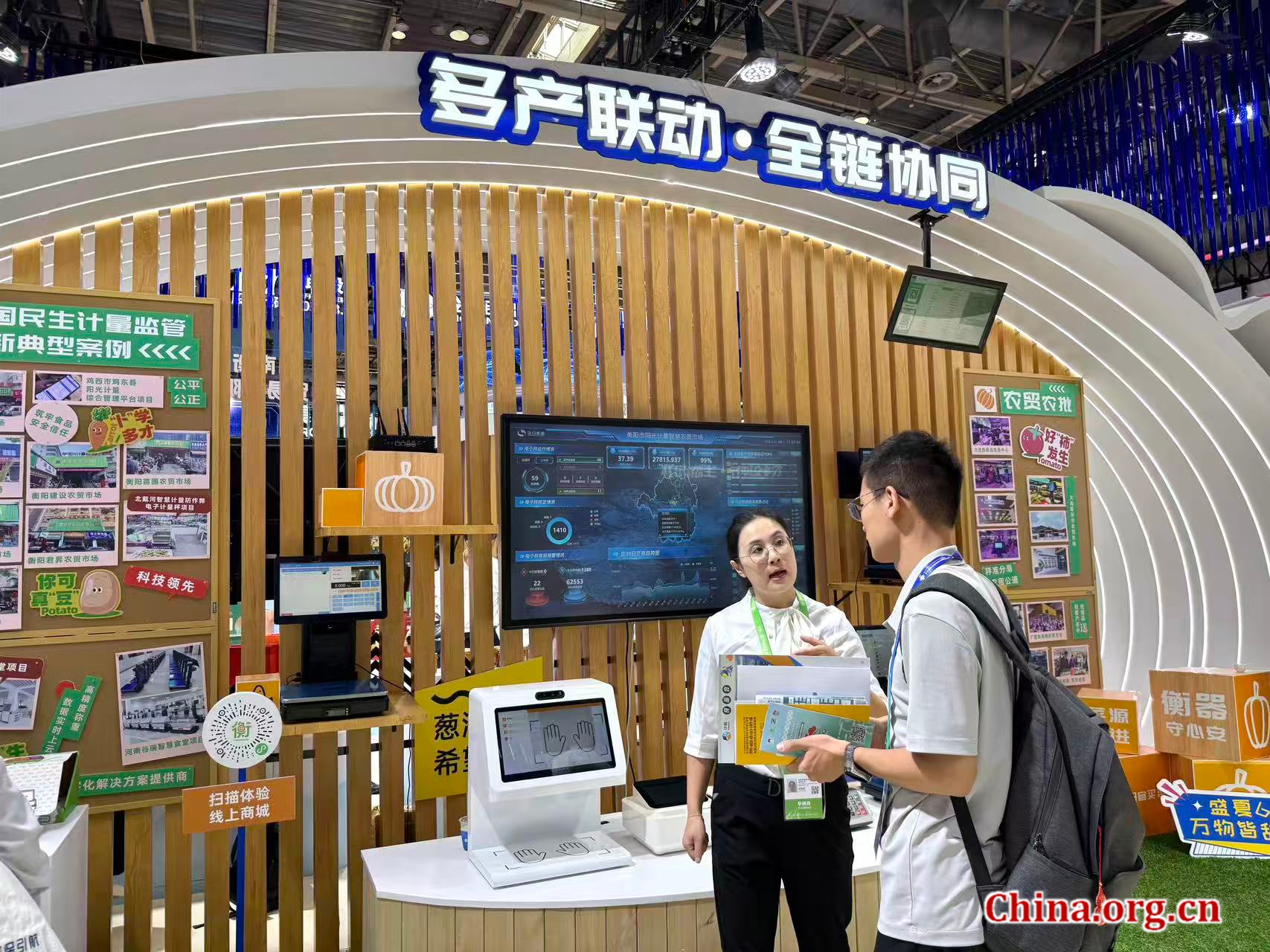
A staff member of Jinma Weighing Apparatus speaks with a visitor at the expo in Beijing, June 23, 2026. [Photo by Liao Jiaxin/China.org.cn]
"The electronic scales we produce are no longer just scales," Zhou Xin, general manager of the company, told China.org.cn. "They have evolved into intelligent terminals. They have weighing functions, but they also have data capture, real-time transmission, and anti-cheating designs."
The anti-cheating feature, the company says, helps address long-standing consumer frustrations over inaccurate weights — a common complaint in farmers' markets where some vendors have been known to use rigged scales.
But the bigger story, according to Jinma, is what happens with the data. In Hengyang, Hunan province, the company has installed its smart scales in more than 50 farmers' markets, generating a city-wide stream of agricultural product consumption data that is fed back to farming enterprises to guide production decisions.
"We provide this market consumption data to farming enterprises, enabling them to plan production based on actual demand," Zhou said. "We not only give them orders, but also provide agricultural technology to help them increase yields and improve quality."
With real-time data from thousands of daily transactions, producers can better match supply with demand. The system also gives consumers greater traceability, allowing them to verify the origin of meat and produce and check inspection and quarantine certificates.
Jinma also shares its platform with several other domestic firms, stressing an open approach to building an industrial ecosystem. "We want to build an industrial ecosystem, not a walled garden," Zhou said. "We are open and inclusive. If you only play by yourself, you can't grow big. Sharing and co-building is the way to make the ecosystem healthier."
That openness was evident at this year's expo. On June 23, the company and its subsidiary signed two cooperation agreements worth a combined 200 million yuan ($27.6 million) — one to build a two-way agricultural supply chain between Hainan and Hunan provinces, and another to launch a fully traceable livestock product system.
"The seller wants to know if the cattle are raised healthily and whether there is full traceability," Zhou said. "The producer, meanwhile, may have massive production capacity but not know who to sell to. We act as a bridge and technology enabler — so they know each other, and they can develop together."
"We connected with our current partners at the very first CISCE," Zhou recalled. "This year, we're signing together with upstream and downstream partners. From cattle farming to digital management to the consumer end, we are closing the loop."
Looking beyond the expo, Jinma plans to expand its smart-scale network from Hunan province into five other provinces and regions — Hainan, Yunnan, Guangxi, Sichuan and Hubei — to build a more precise, real-time data platform for agricultural planning and policymaking.
"This changes the old way of relying on surveys and estimates," Zhou said. "Now we have real, reliable data. It helps governments make informed decisions, helps producers plan scientifically, and gives consumers better protection and a safer shopping experience."