 China International Supply Chain Expo
Chinese firms lead globally in AI fitness, PwC report says
Source: China.org.cn Release time: 2026/06/24
PwC released its Global AI Performance Study China Report at the China International Supply Chain Expo (CISCE) in Beijing on June 22, highlighting the strengths and growth potential of Chinese enterprises.
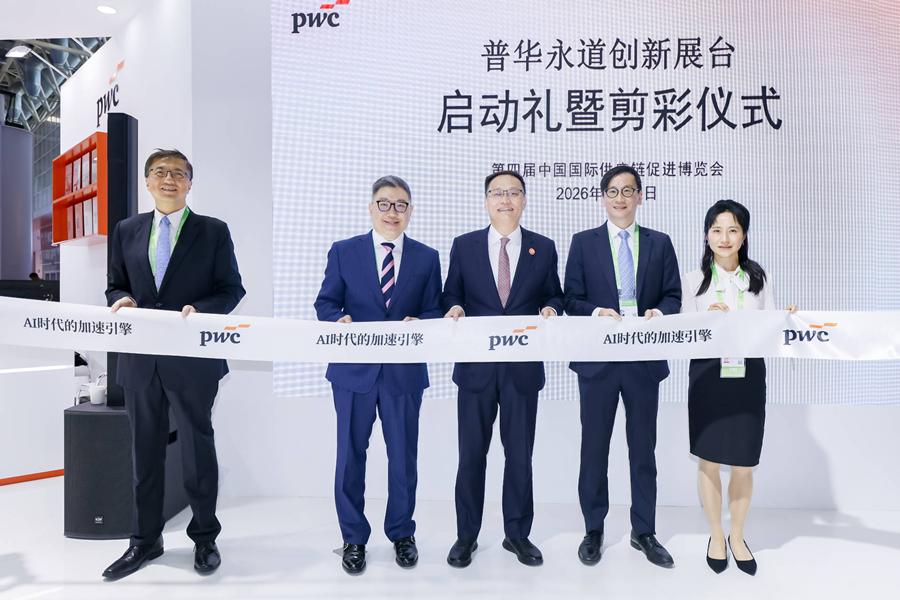 PwC executives attend a ribbon-cutting ceremony at the China International Supply Chain Expo (CISCE), Beijing, June 22, 2026. [Photo courtesy of PwC China]
The report draws on a benchmark assessment of 1,217 enterprises across 25 industries worldwide, examining Chinese companies' AI fitness, application capabilities and foundational capabilities against those of global AI leaders.
"Enterprises should move beyond the stereotype of 'AI for cost reduction' and proactively tackle advanced application scenarios, using AI to tap into emerging cross-industry value pools and explore business model reinvention," said Horatio Wong, head of consulting at PwC China. "Only by promoting strategic closure, innovation resilience and institutional development in tandem can the long-term compound effect of AI be truly unleashed."
Chinese enterprises rank among the global top tier in AI fitness, surpassing the global average and outperforming recognized AI leaders in some areas.
In application capabilities, Chinese firms lead global peers in cross-enterprise collaboration, customer demand response and cross-industry ecosystem value, with cross-industry collaboration penetration about 2.3 times the global average.
The report found that enterprises it classifies as AI leaders generate 7.2 times the AI-driven financial performance of other enterprises. They do so by targeting core business challenges, building tailored technology foundations and embedding AI deeply into their operations.
Chinese enterprises overall, however, tend to be stronger on application growth and scaling than on the underlying foundations — lagging in particular on advanced autonomy and self-optimization.
"China's AI is already at a globally leading level, with execution-oriented applications deploying fast and scaling strongly, and innovation investment even exceeding that of global leaders," said James Lee, leader of AI consulting at PwC China.
"Many of the enterprises we serve have chosen to co-develop solutions with third-party professional service firms and technology providers during their AI transformation, enabling rapid deployment and iteration in real-world settings to achieve results faster," Lee added.
The report also identifies shortcomings. Despite high AI investment levels, Chinese companies show significant gaps in autonomous decision-making and resource allocation flexibility.
The report urges them to define a clear AI value proposition, pinpoint priority areas with competitive advantages and tie outcomes to specific performance indicators, while building out capabilities across return efficiency, resource optimization, application upgrades, infrastructure and compliance governance.
PwC's AI Fitness Index measures how effectively enterprises convert AI capabilities into business returns, drawing on 60 management and investment practices across nine impact factors spanning strategy, technology, governance, workforce and industry integration.
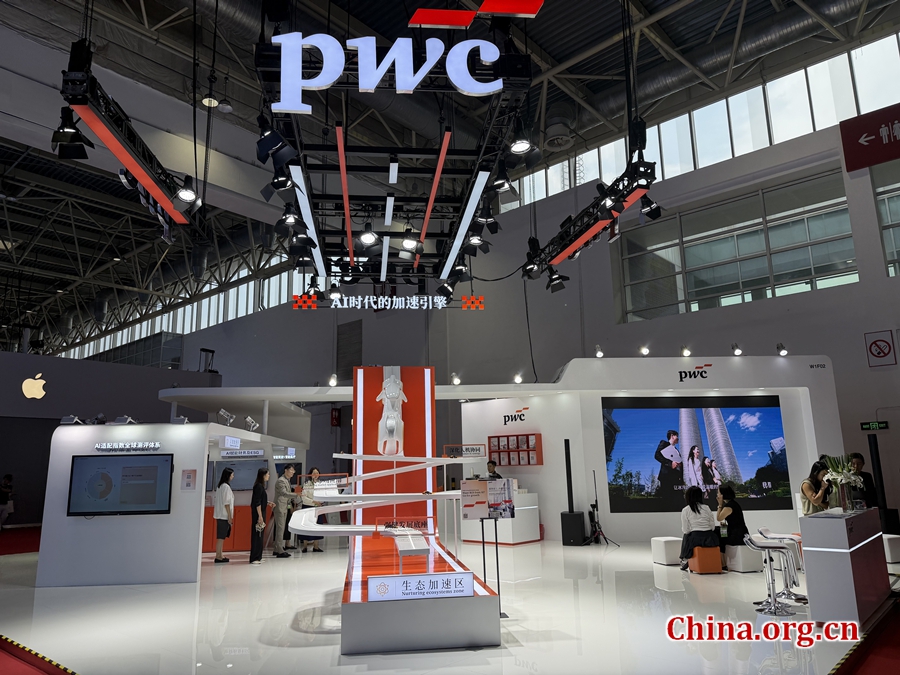 PwC's booth at the China International Supply Chain Expo (CISCE) in Beijing on June 23, 2026. [Photo/China.org.cn]
At CISCE, PwC China is showcasing AI applications in supply chains alongside 12 ecosystem partners, with its "AI Racetrack" installation tracing the progression from infrastructure building to cross-industry deployment and human-AI collaboration.
"We hope to use CISCE as a platform to connect with more clients and support their AI transformation, helping them realize the value AI can create," Cindy Chen, partner of government affairs at PwC China, told China.org.cn.